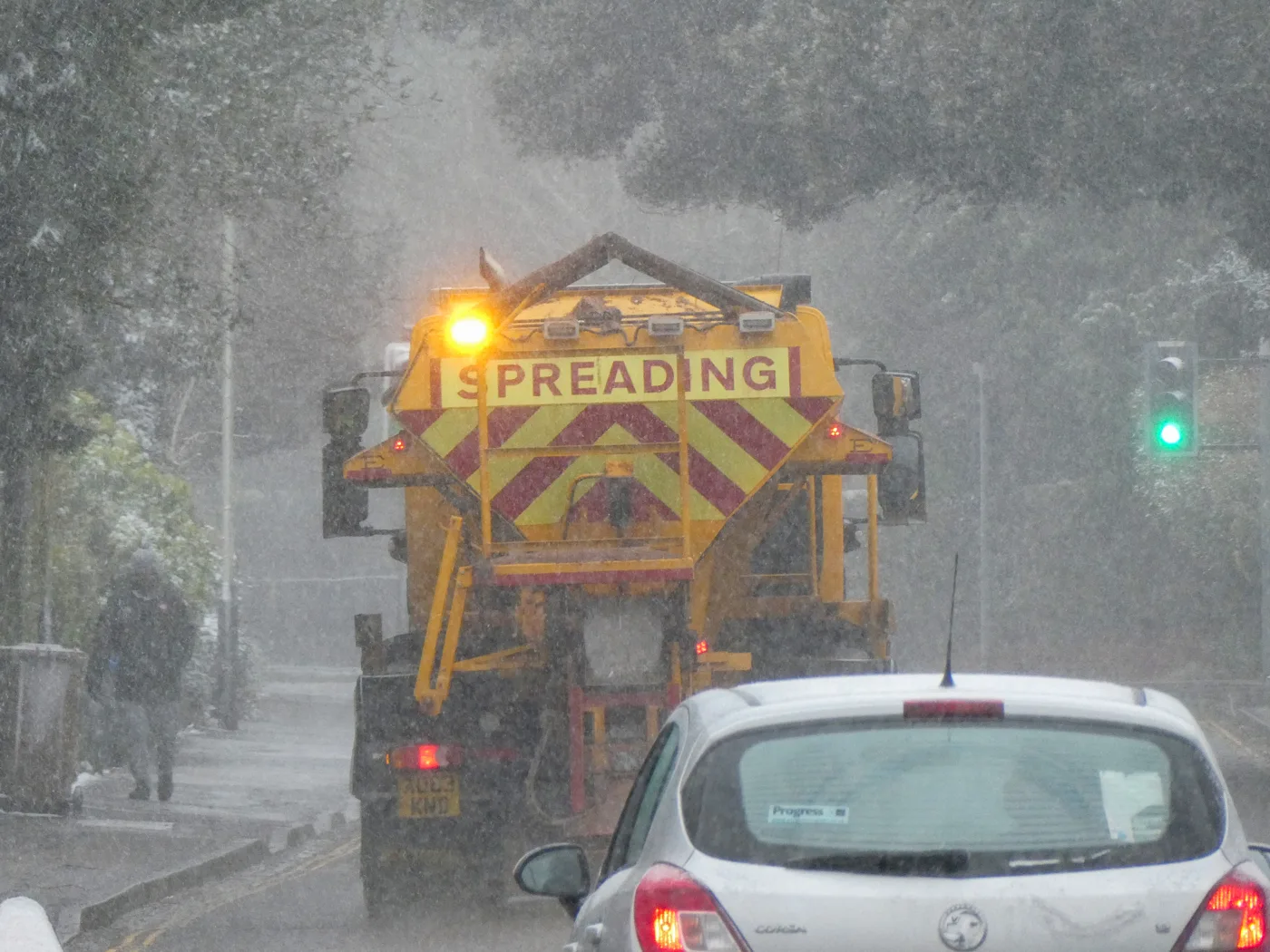

West Northamptonshire grits 1,100 km of priority roads from 12 gritters once the forecast hits 0.5C. Most side streets get nothing: check the map and grit bins.
West Northamptonshire Council grits about 1,100 km of priority roads whenever the forecast road temperature drops to 0.5C or below, using a fleet of 12 gritters run by its highways contractor Kier. Everything else, which is most residential streets in Northampton, Daventry and Towcester, gets no treatment at all. Whether your road is on the list is shown on the council’s interactive map, and the council’s own advice is never to assume a road has been done.
The quick answer
- Which roads: the priority network only, about 1,100 km, shown on the council’s gritting route map. The council says “the majority of minor roads will receive no treatment at all”.
- When: whenever the forecast is +0.5C or below. Crews are on standby 24 hours a day through the winter.
- Grit bins: 885 across the area, filled at the start of winter. Report an empty one on Fix My Street. The salt is not for private drives.
Which roads are gritted
The council splits the roads it is responsible for into two networks, according to its gritting page, last updated on 7 April 2026:
- The precautionary network (P1). Salted “whenever there is a potential hazard with forecast temperature of +0.5 or below”. This is the routine winter run: the main roads through the towns, the bus routes and the roads that link villages.
- The adverse network (P2). Pre-treated during the day when there is high confidence of snow in the forecast, or when the temperature is not expected to rise above zero for 48 hours, and then only if the P1 network needs no further treatment.
The M1, A43 and A45 trunk sections are not the council’s job. Motorways and trunk roads are gritted by National Highways.
The routes are reviewed once a year. If you want your road added, the council asks for the request by email through its gritting page before September, so that it can be considered for the coming winter. Unadopted (private) roads are never gritted; their owners are responsible. New roads and paths are only considered once they have been adopted.
The council’s explanation for why most streets go untreated is a plain one: “We have a finite gritting resource which needs to be applied in the most effective way.” The busiest roads and those linking communities come first.
Pavements
Footways are not on the gritting run. The council says “consideration is given to the treatment of priority pedestrian and cycle routes”, chiefly the main shopping and pedestrian areas, so Northampton town centre and the town centres of Daventry, Towcester and Brackley can expect some treatment in a cold snap. A residential pavement will not be salted.
The fleet and the salt
The figures come from the council’s announcement of 20 November 2025 that the fleet was ready for winter, and the equivalent notice of 23 October 2024:
| Winter 2024/25 | Winter 2025/26 | |
|---|---|---|
| Gritters on standby | 12 | 12 |
| Salt stockpiled | 5,500 tonnes | 5,000 tonnes |
| Priority routes treated | 1,100 km | 1,100 km |
| Grit bins | 880 | 885 |
| Trigger temperature | below 0.5C | 0.5C |
Kier’s crews are on standby 24 hours a day, and every gritter can be fitted with a snow plough. The council uses route-based forecasting rather than a single reading for the whole area, so a run can go out for the higher roads around Daventry when Northampton is above freezing.
Two things worth knowing about how salt behaves, both from the council’s own material. First, in Kier’s words from 2024, “once a road has received gritting treatment, the salt requires activation from vehicle movement”: a gritted road that has had no traffic can still be icy first thing. Second, the grit is salt mixed with molasses so it is not washed or blown off the road so easily, but it stops working at about minus 10C.
Grit bins: where they are and how to get one filled
The council’s grit bins page, last updated on 7 April 2026, gives the count by area as at 2022:
| Area | Council grit bins |
|---|---|
| Daventry | 354 |
| Northampton | 221 |
| South Northamptonshire | 310 |
| Total | 885 |
All council-owned bins are inspected and filled at the start of the winter. After that, refills depend on “available resources, their usage and the severity of the weather”. Report an empty bin on Fix My Street. The salt is for the public highway and pavements: “not intended for use on private drives and paths”.
Asking for a new bin is done by email to the council, and the location has to meet at least five of these tests: on the public highway; a sharp bend; a junction with a gradient; a slope of 10 per cent or more; close to a community facility; the only access to a community area; a known problem site; outside the precautionary gritting network; and at least 150 metres from the nearest existing bin. Where a spot fails the tests, a town or parish council can put in its own bin with the council’s approval, which is why some villages have more bins than the count suggests.
When it snows
Roads are cleared “in priority order as soon as conditions permit”, starting with the P1 network, and clearance carries on as long as needed. School closures are decided by each school. Bin collections are the other casualty of a snowy week: our bin collection days page explains how the council catches up, and the Christmas bin collections page has the revised festive dates. Live disruption on the roads is on our roadworks and travel page.
Still to be confirmed
The council’s 2026/27 winter announcement, with this year’s salt stock and any change to the fleet. The last two came on 23 October 2024 and 20 November 2025. This page will be updated when it lands.
Sources
- West Northamptonshire Council, Gritting West Northamptonshire, last updated 7 April 2026
- West Northamptonshire Council, Grit bins, last updated 7 April 2026
- West Northamptonshire Council, West Northamptonshire’s gritting fleet on the move, 20 November 2025
- West Northamptonshire Council, Gritting fleet geared up for the winter months, 23 October 2024
- West Northamptonshire Council, gritting route map
Have your say